NFT Market 2025: Supply Up, Prices Down—How Physical Art Tokenization Wins
The 2025 NFT market moved decisively into a high-volume, low-price phase: creators minted more, while buyers spent less per item and less overall. For artists, galleries, and brands, that shift doesn’t mean “NFTs are dead” — it means lazy drops get diluted fast, and the winners lean into provenance, storytelling, utility, and real-world credibility (especially when tokenizing physical art).
One practical response is to treat NFTs less like lottery tickets and more like digital wrappers around real assets and real communities — which is where an NFT-focused partner like Hoken Tech can fit into the stack (strategy + tools + distribution/content).
2025 in numbers: supply up, sales down
From the data from CoinGecko and CryptoSlam we see:
Total NFT supply grew to 1.34 billion in 2025, up 25% from 1.0 billion in 2024. (Source: CryptoSlam)
Total NFT sales fell to about USD 5.63B in 2025, down 37% from USD 8.9B in 2024. (Source: CryptoSlam)
Average sale price slipped to USD 96 (2025) from USD 124 (2024), far below the ~USD 400 averages seen during the 2021–2022 boom. (Source: CryptoSlam)
NFT market cap compressed to about USD 2.4B by end of 2025, down from ~USD 10.8B in Dec 2024 and ~USD 17B peak in Apr 2022. (Source: CoinGecko)
Average NFT sale price
Source / citation
Note: “Average sale prices… slipping to USD 96 from USD 124… far below the USD 400 averages seen during the 2021 and 2022 boom.”
The deeper trend: 38M to 1.34B NFTs in four years
From the data we highlights a massive supply expansion:
2021: 38M
2022: 106M
2023: 550M+
2024: 1.0B
2025: 1.34B
That’s roughly a 35× increase (~3,400% growth) over four years. (Source: CryptoSlam)
What this means in practice: attention and liquidity are being stretched across an enormous inventory. So projects without a sharp concept, verifiable authenticity, or buyer incentives get lost.
Total NFT supply (circulating)
Source / citation
Note: “Total NFTs in circulation climbed to more than 1.34 billion… 25% increase from one billion in 2024.”
Why “digitizing physical art” is a strong counter-trend
In an oversupplied market, scarcity and credibility matter more than ever. Physical art has built-in advantages:
Natural scarcity (one original, limited editions)
Story + provenance (artist, medium, exhibitions, ownership history)
Real-world value anchors (collectors understand physical markets)
Better fit for utility (certificates, access, experiences, licensing)
In short: if buyers are spending less per NFT, you can compete by offering more reality per token — clear rights, verified origin, and collector-grade documentation.
Weekly rebound signal (snapshot)
Source / citation
Note: “Volume… rose ~10%… reaching USD 69M…”
Where Hoken Tech fits
Hoken Tech focuses on connecting brands to people through NFTs, leveraging this channel both globally and economically, allowing NFT artworks to be digitally monetized.
Having operated on the Italian and international markets for several years, Hoken Tech has gained the necessary experience, thanks to various collaborations with national and international artists, such as Juan Tardivo, as well as associations and foundations, such as the CEA Foundation, to oversee all phases of the project, from collection management to project implementation, including integrations with Web3 video games and exclusive access via NFTs.
A practical playbook: turning physical art into NFTs (without getting diluted)
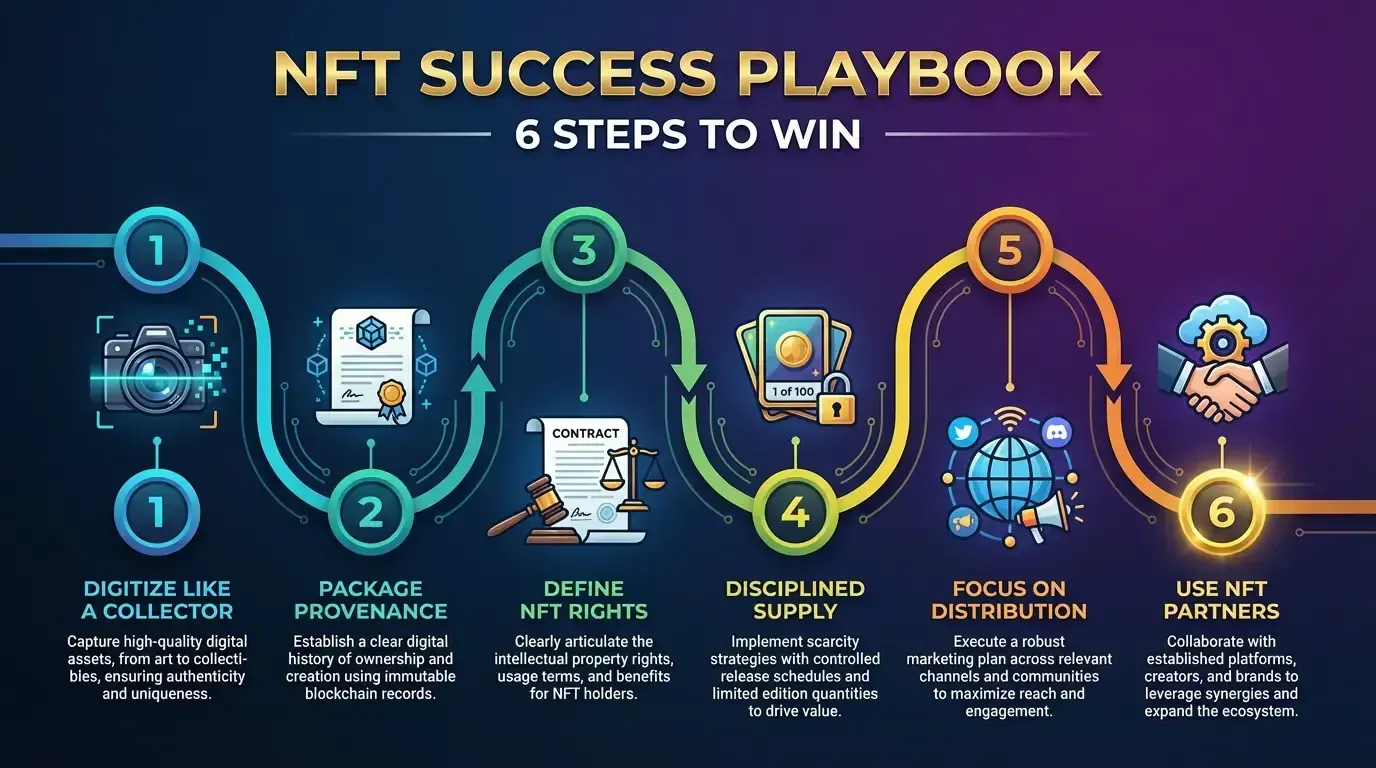
1) Digitize like a collector would inspect
High-resolution scans or controlled-light photography
Detail shots (texture, signature, edges)
Optional: short “studio proof” video of the piece
2) Package provenance (this is your edge in 2026)
Certificate of authenticity (COA)
Edition number, size, year, medium, condition notes
Artist statement + documentation (exhibitions, press, prior sales if relevant)
3) Define what the NFT actually grants
Oversupply punishes vague promises. Spell out:
What transfers on sale: token ownership vs copyright/licensing
Redeemability: can the NFT be redeemed for the physical artwork?
Collector perks: studio visits, private drops, print rights, event access
4) Mint with disciplined supply
In a market where supply is exploding, discipline signals seriousness:
1/1 for originals
Tight editions for prints (e.g., 25–150), not 10,000 unless you’re a brand with distribution
5) Distribution > minting
Most projects fail on distribution, not tech:
Collector outreach, gallery partners, communities
Cross-posting stories, behind-the-scenes, drops calendar
Secondary market support (clear metadata, consistent collection page)
6) Use an NFT partner for execution and messaging
This is a natural insertion point for Hoken Tech: positioning, narrative, go-to-market, and tooling support around NFTs so you don’t ship a technically-minted project that nobody sees.
If you’re an artist, gallery, or brand looking to bring real-world assets to Web3, explore our solutions at Hoken Tech, where we focus on connecting brands to people through NFTs.
If credibility is your priority, our emphasis on authentication aligns well with what collectors increasingly demand: proof, provenance, and trust.
No — your data shows a market shift, not a disappearance: supply rose while sales and average prices fell (high-volume, low-price). That usually means speculation cooled, and buyers demand higher quality and clearer value.
Minting got easier and cheaper, so creators kept producing — while buyer liquidity and attention didn’t scale at the same pace. Result: more inventory competing for fewer dollars.
Work with strong identity + provenance, clear rights/utility, and consistent release discipline. Physical art tokenization can help because it’s naturally scarce and documentation-friendly.
At minimum:
High-quality media files
Metadata (title, medium, year, dimensions, edition)
Provenance/COA references
Clear statement of rights and redemption terms (if any)
Use that number as a reality check, not a rule. Consider:
Entry-level editions for discovery
Premium 1/1s for collectors
Bundles tied to physical ownership, access, or licensing
Test pricing in phases rather than overcommitting on day one.
Usually no — copyright and licensing depend on what you explicitly grant. Put it in writing (listing description + terms), and consider legal review for high-value drops.
Document the creation process, keep consistent metadata, publish edition rules, and provide verifiable provenance. The market is increasingly rewarding trust signals over hype.
Hoken Tech focuses on NFTs to connect brands and people and provides resources, tools, and projects in the NFT space. For art projects, this can include strategy, packaging, positioning, and launch/distribution support. For more information, you can contact them here.

nft, hoken tech, blockchain, cryptoart, eos, nft art, artificial intelligence, ai, watch authentication, crypto artist, nfts, web3, nft game, web3 game, videogame, nft distributor, videogame blockchain